

👋 Hi, it’s Kaylee Edmondson and welcome to Looped In, my newsletter exploring demand gen and growth frameworks in B2B SaaS. Subscribe to join 1k+ readers who get Looped In delivered to their inbox every (well, typically anyway) Sunday .
After a much-needed reset, we’re back! A quick preamble that no one asked for and then onto the good stuff. We both know you opened this email really in part because I’ve been inconsistently showing up here lately—apologies! I crammed so much into the back half of 2024 that I personally needed a reset. Plus 2025 client planning started taking off and something had to give.
So, now that that’s out in the open, what am I doing differently for 2025? Well for one, I’ll be here weekly. Maybe on Sunday’s or maybe I’ll experiment with different days of the week based on how the client load shakes out. And I’m slated to partner with a handful of really epic brands to help them build their GTM engines—and yes, of course, I’ll be anonymizing those learnings and bringing them here to share them with you all.
And the one gripe I have about email as a medium is that it often feels like I’m writing into a void. I’m a real person, and any replies to these emails come directly to my one and only inbox. I would love to hear what you’re up to this year! What are you most excited about (personally or professionally)? And what’s one thing challenging you?
Ok…let’s get to the good part.
Demand Gen Strategy & Predictions
The year of orchestration – signals will drive plays that fuel demand loops
We went through the era of intent which was really just comprised of first party data (1P). 1P data is all fine in itself, but it just didn’t give marketers much of a head start to create meaningful impact from seeing a high intent, already-cookied, prospect visiting your pricing page. Or even worse, getting a Slack alert letting you know someone from Salesforce was visiting your pricing page. But 2025 will be the year we all move to signals which is what I’m considering 1P, 2P, and 3P activities, insights, and data that can inform an action. Data is no longer just a nice-to-have—it will be the backbone of high-performing demand gen strategies. Marketers will get better at orchestrating signals across multiple platforms (website visits, ad engagement, social interactions, outbound, and third-party intent tools). Instead of running generic nurture sequences, we’ll see more real-time, multi-channel plays where ads, emails, and outbound motions shift dynamically based on a buyer’s latest activity and market signals. Think of it as marketing that finally listens vs. just tells.
PLG and demand gen will merge into one growth engine
For years, product-led growth (PLG) and demand gen have operated in parallel—one focused on driving free sign-ups, the other on sales-led motion. In 2025, I’m predicting the lines will blur. Marketers will focus more on monetizing intent—not just capturing leads—by layering in sales-assist strategies, expansion plays for existing users, and growth loops that create self-sustaining demand. The best teams will start measuring usage-based intent (e.g., how often a free user engages with certain features) and triggering highly relevant outreach at the right moment. In the same way that the person running paid social and organic social have traditionally been two distinct roles and basically left to operate in silo and never swap learnings, I think traditional PLG growth and sales-led demand gen roles will finally break those silos.
AI-generated content will fuel hyper-personalized plays at scale
AI is no longer just for blog posts—it’s reshaping how demand gen teams personalize at scale. In 2025, AI tools will generate hyper-relevant outreach, dynamic landing pages, and even tailored video content based on a prospect’s industry, company size, and intent signals. Imagine an AI-powered demand gen system that not only personalizes subject lines but also rewrites entire nurture sequences to align with a prospect’s latest interactions. The brands that win will stop thinking about AI as a content factory and start using it as a real-time personalization engine.
Cold outbound will be rebranded as “strategic activation”
Let’s be real—cold outbound isn’t dying (and neither is every other tactic FWIW), but in 2025, it’s evolving. The days of mass-blasting lists with generic outreach are well over. The best demand gen teams will take a surgical approach, using buyer triggers (funding rounds, job changes, product launches, market shifts, industry newsjacking, nearbounding, etc.) to craft highly relevant outbound plays. Expect a shift toward multi-threaded, multi-channel activation, where prospects are warmed up through targeted LinkedIn content, direct mail, and thought leadership before the sales touch. The goal? Make outbound feel like an extension of the buyer’s journey, not an interruption. Partially a plea, and partially a prediction, but let’s please make this the year marketing and sales are building account plans and plays together. And not spending all our time in the trenches of the attribution war.
Demand Gen finally evolves from a function to a company-wide growth mindset
I’ve said it for years, but right now, “demand gen” is a catch-all for everything revenue-related that isn’t explicitly sales/closing. If you ask 100 companies what demand gen owns, you’ll get 97 different answers—because today’s demand gen leads are running paid search, paid social, content, events, ABM, lifecycle marketing, SEO, inbound routing, and even parts of marketing ops. Today demand gen is seen as a function—a team responsible for inbound pipeline generation. But in 2025, demand gen won’t just be a marketing responsibility—it’ll be a company-wide priority.
The best companies will treat demand gen as a growth engine that spans marketing, sales, customer success, and even product. That means breaking the traditional structure and embedding demand gen thinking into every part of the GTM motion.
Here’s how I think the role gets a facelift:
1. Demand Gen Moves Closer to Revenue & Sales Execution
The old model: Demand gen teams obsess over MQLs, pass them to sales, and hope for the best.
The new model: Demand gen leaders will work hand-in-hand with revenue teams to run pipeline acceleration plays—aligning on intent-based outreach, content-driven sales motions, and multi-threaded account engagement.
🚀 What changes? Demand gen KPIs will shift from just lead volume to pipeline velocity, sales cycle efficiency, and win rates.
2. Marketing, Sales & CS Will Share Demand Gen Responsibilities
Right now, demand gen is mostly about acquisition. But in 2025, companies will recognize that retention and expansion are just as critical to growth as new pipeline.
Customer success will take on a bigger role in demand gen, running expansion campaigns and customer advocacy plays.
Sales teams will get more involved in content co-creation and social selling.
Product teams will help drive demand by building in viral growth loops and in-app conversion moments.
🚀 What changes? Demand gen will shift from just creating demand to monetizing and expanding it across the full customer lifecycle.
3. Demand Gen Teams Will Become Mini Growth Agencies Inside the Company
Instead of just executing campaigns, demand gen teams will act as internal growth consultants—identifying revenue opportunities and building cross-functional plays across marketing, sales, and product.
Running account-based demand gen plays with SDRs.
Partnering with content & creative teams to build high-impact narrative campaigns.
Aligning with RevOps & AI-driven analytics to optimize the entire funnel, not just top of funnel.
🚀 What changes? Demand gen teams won’t just “do marketing” anymore—they’ll be embedded in GTM strategy, revenue expansion, and product-led growth.
Bottom line…Demand gen is a company focus, not strictly a function.
The companies that win in 2025 will break out of the old-school mindset where demand gen is just a marketing function and start treating it like what it really is: a company-wide, cross-functional growth discipline.
The AI Effect: digital channels will saturate in months, not years
We all know this, but it does need to be called out. First mover advantage has never been more critical thanks to AI. Pre-AI there was more natural, slower saturation because channel maturity had to be achieved through personal mastery. Post-AI there will be insane acceleration because channel mastery will happen nearly instantly. Your entire team should be maniacally focused on how to integrate AI into workflows and experimentation. And every new teammate you bring on should have a keen perspective on how they can leverage, test, and iterate with AI against their current and future responsibilities.
Organizational Changes
The rise of the new-age CMO
Kieran Flanagan posted this take a few months back and it quickly became my Roman Empire. The premise is that the more senior you become in your role, the worse your tactical marketing knowledge actually becomes. At the pace of change and innovation, I just don’t see marketing leaders being able to stay ahead and hit growth goals continuing to operate this way.
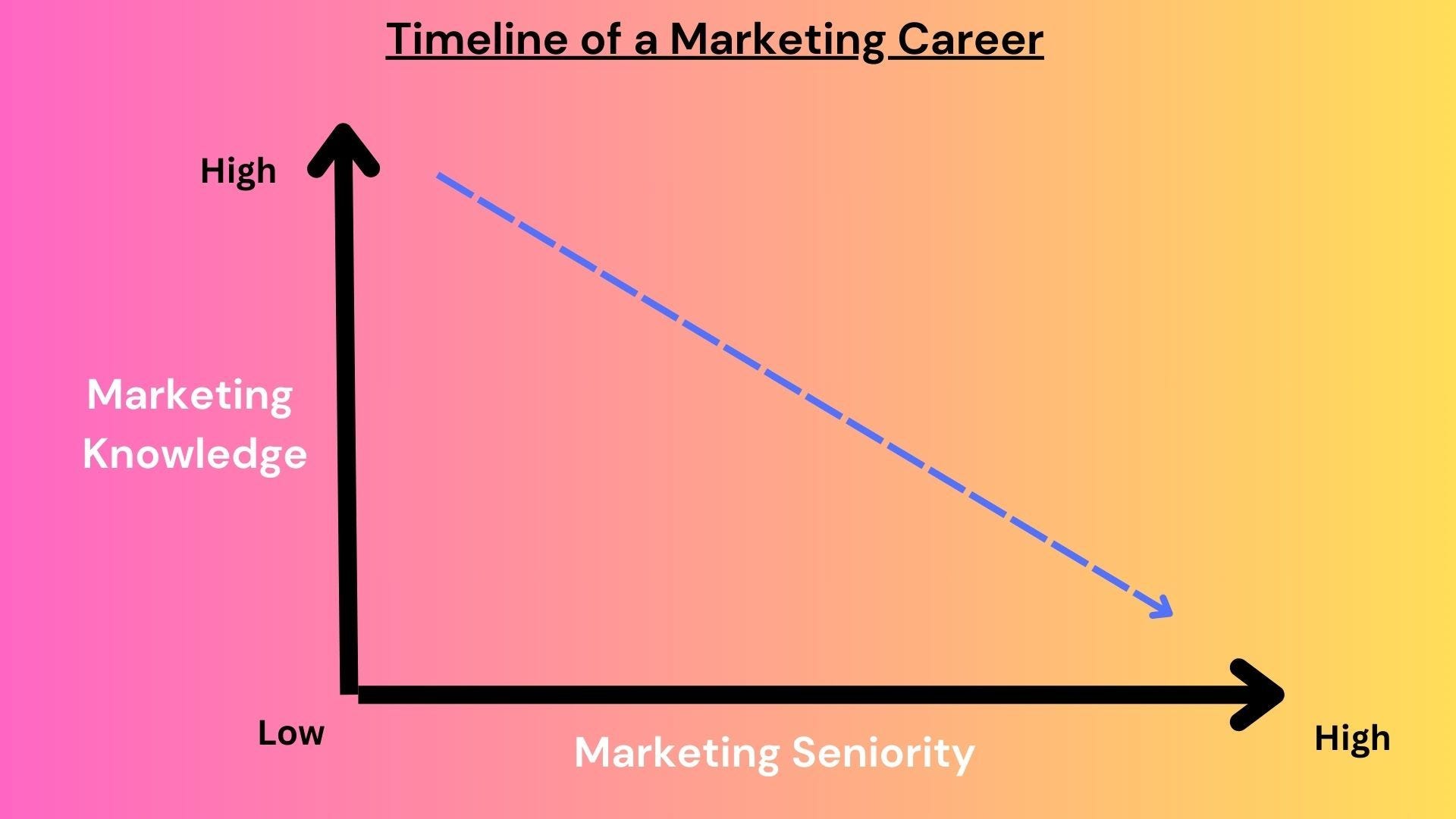
I already see this happening, but the top 1% of CMOs are still practitioners in a few areas. They’re staying sharp and close to the problems the org is trying to solve. I see this being a differentiator for brands that are able to take advantage of being an early adopter.
(Before any of you come for me, seniority in this graphic refers to the role you hold and is age-agnostic.)
Teams will shrink W-2s and rely more on contractors
It’s proven time and time again that 100 person marketing teams actually make the pace of shipping campaigns, identifying plays, building infrastructure, etc. slower, not faster. Larger teams are often weighted down by processes, internal red tape and approvals, and with more cooks in the kitchen.
In 2025 I see more teams shrinking their W-2 fixed cost and instead rely more heavily on specialized contract resources for more project-based execution.
Top CMOs will own the entire acquisition engine
There are few today that own the full engine hence the war on attribution continues. As we move into a signal-based era, CMOs get closer to being the driver of both strategy and execution, and goals aren’t getting any smaller for revenue leaders, it’s time CMOs own the entire acquisition engine. Both “inbound” and “outbound” (or better said, the BDRs).
Process efficiency, and goal alignment matter. This solves for all the back and forth on if Opps were “inbound sourced” vs “outbound sourced” and allows teams to pay attention to what matters. Are these series of plays and signals driving Opps, or not? What series of actions are driving the best-fit customers with the best Cost of Growth? Period.
And those are my 2025 predictions. Officially memorialized. We’ll see how it pans out. Good luck out there!
And seriously if you’ve made it this far…I would love to hear what you’re up to this year! What are you most excited about (personally or professionally)? And what’s one thing challenging you?
See you next week,
Kaylee
This is fantastic!