

A few weeks ago I wrote about 11 use cases I’m running in Claude. That post was about the tool that seems to be winning the AI GTM race (at least for now) but I wanted this post to focus on the plays themselves.
Kyle Poyar and Brendan Short just published an excellent piece on AI-native GTM plays. Closed-lost re-engagement. Micro-campaigns. Champion tracking. All powerful, outbound-first plays. Every one ends with an AI agent drafting an email to a prospect.
I kept reading and thinking: nobody is writing about the demand gen side (or if they are, I’m not seeing it so please drop me a note so I can follow them if so).
These are 3 plays I’m running or building across clients right now. They’re demand gen specific and AI-native; meaning they either weren’t possible before or would have taken 10x longer without AI in the workflow.
Let’s get into it.
👋 Hi, it’s Kaylee Edmondson and welcome to Looped In, my newsletter exploring demand gen and growth frameworks in B2B SaaS. Subscribe to join 2k+ readers who get Looped In delivered to their inbox every Sunday. If you’re not subscribed yet, fix that below.
Play 1: Infrastructure Debt Remediation
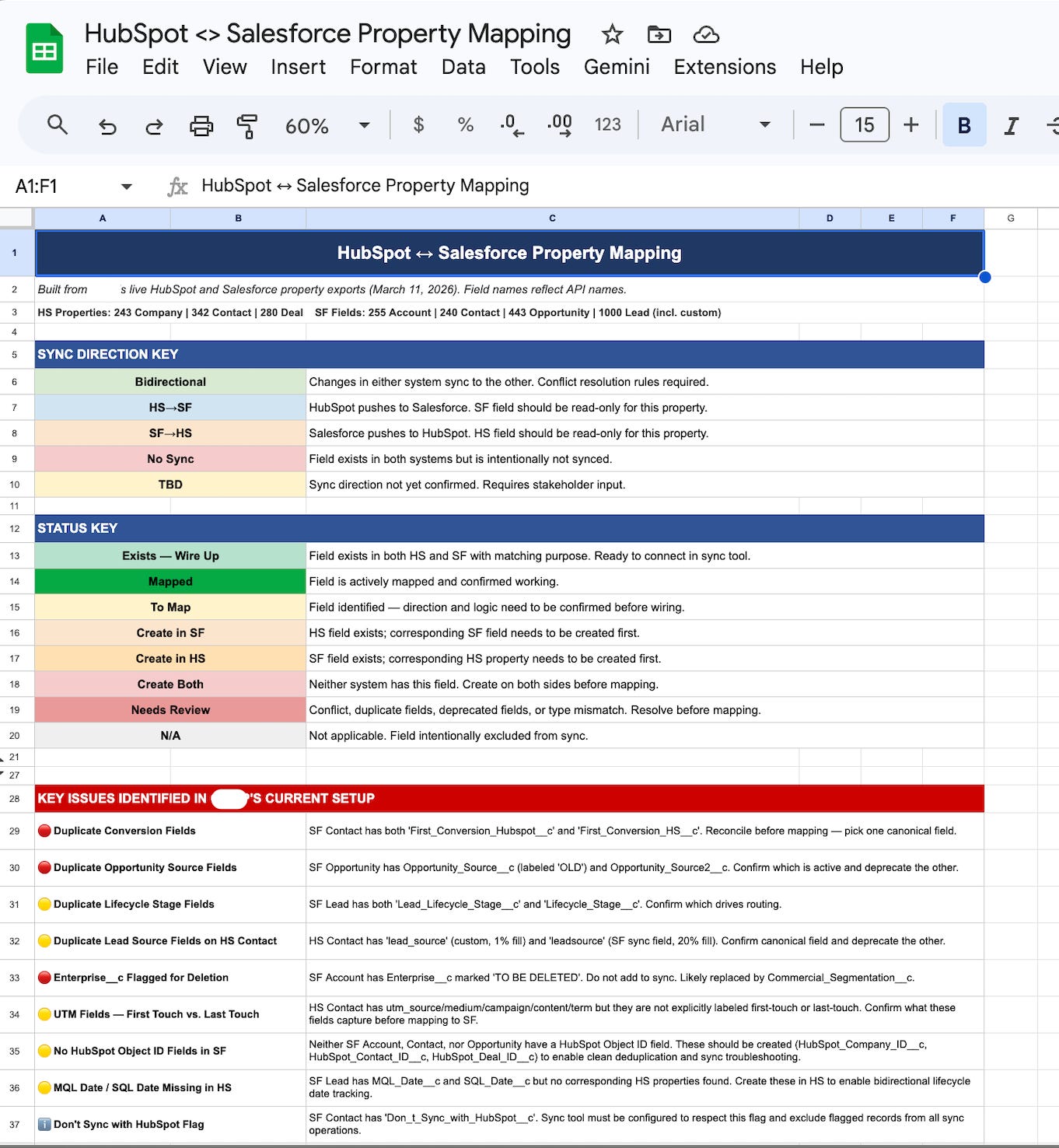
I joined a client engagement earlier last year. Opened HubSpot. 67 lead source values. Multiple duplicate UTM fields. Thousands of duplicate Contacts and Companies. Dozens of sync errors affecting the HubSpot <> Salesforce integration so badly that it was disconnected in order to clean up both instances.
The old playbook for this is brutal. You open a spreadsheet and start documenting. Weeks later, you’ve mapped half of it. You fix what you can, work around what you can’t, and pray that nothing breaks when you finally reconnect the sync.
What I did instead: I used AI to audit the full property list across both systems. It mapped fill rates for every field, flagged duplicates and near-duplicates across naming conventions, and drafted a consolidation plan (old value to new value, with reasoning for each). For lifecycle stage workflows, it QA’d each one against the Salesforce-side flow to flag sync gaps. For the integration rebuild, it generated 100+ property mapping rules by pulling field types, checking for conflicts, and catching where previous configurations created redundant paths.
I still made every decision around which lead sources to consolidate, what the lifecycle stages should be, whether a field gets deprecated or remapped, but AI did the pattern recognition across hundreds of fields and the cross-system comparison. Honestly, the stuff that used to take days of uninterrupted eyeball-scanning admin panels.
Play 2: Signal Identification and Backtest
Most teams treat signal data the same way: buy an intent tool, get a list of “surging” accounts, hand it to the BDR team, hope something sticks. The signals are generic and therefore so is the response if you’re lucky. And nobody can tell you whether those signals actually predicted anything after the fact.
I’ve been approaching this differently.
I built a custom AI skill called GTM Alpha (built off exactly what Clay coined the term for) that helps identify non-obvious data points for a specific company’s market. Not the standard firmographics and intent data everyone else already has. It’s trying to dig deep to find the stuff that sits in the right half of the uniqueness spectrum: hard to find at scale, specific to your buyer’s world, and more predictive than what your competitors are looking at.
The skill takes in your ICP, your product, your competitive landscape, and your best-customer profile, then generates ranked lists of data points you should be tracking. Things like specific job posting patterns that indicate a company is mid-migration, or public signals on review sites that correlate with buying urgency for your category.
But generating hypotheses is only half the play. The other half is backtesting.
This week I ran this with a client, a customer evidence platform. We took the GTM Alpha output (the hypothesized signals that should predict buying behavior for their specific product) and backtested it against their most recent cohort of Closed Won accounts. The question was simple: do accounts that eventually closed won actually show these signals before they entered the pipeline?
Where to start: Pick your last 20-30 Closed Won accounts. Before you generate new signal hypotheses, look at what those accounts had in common before they entered your pipeline. What was on their careers page? What were they posting about on LinkedIn? What tools were they hiring for? What review site activity did they have? You’ll start to see patterns that are specific to your market. Those patterns become your signal hypotheses. Then you test whether they hold up across a larger set. That’s your GTM Alpha.
🔗 Here’s the GTM Alpha Skill to try for yourself.
Play 3: Multi-Variant Ad Creative Production
Creative production velocity has been the single biggest bottleneck in paid media for most B2B teams I work with. Aside from budget, which is finite for most everyone, the ability to produce and test enough creative variants fast enough is always hard to prioritize design resources for.
You know the cycle. Typically you write the brief and send it off to design. Then design has a 3 to 5 day turnaround, and you get back 2-3 variants. You pick one and launch. Three weeks later, creative fatigue sets in and you need new variants. Back to the design queue. If you’re running persona-specific or industry-specific campaigns, multiply that cycle by the number of segments. Painful.
For most demand gen teams, this means you run 2-3 creative variants total because that’s all you can get through the production pipeline.
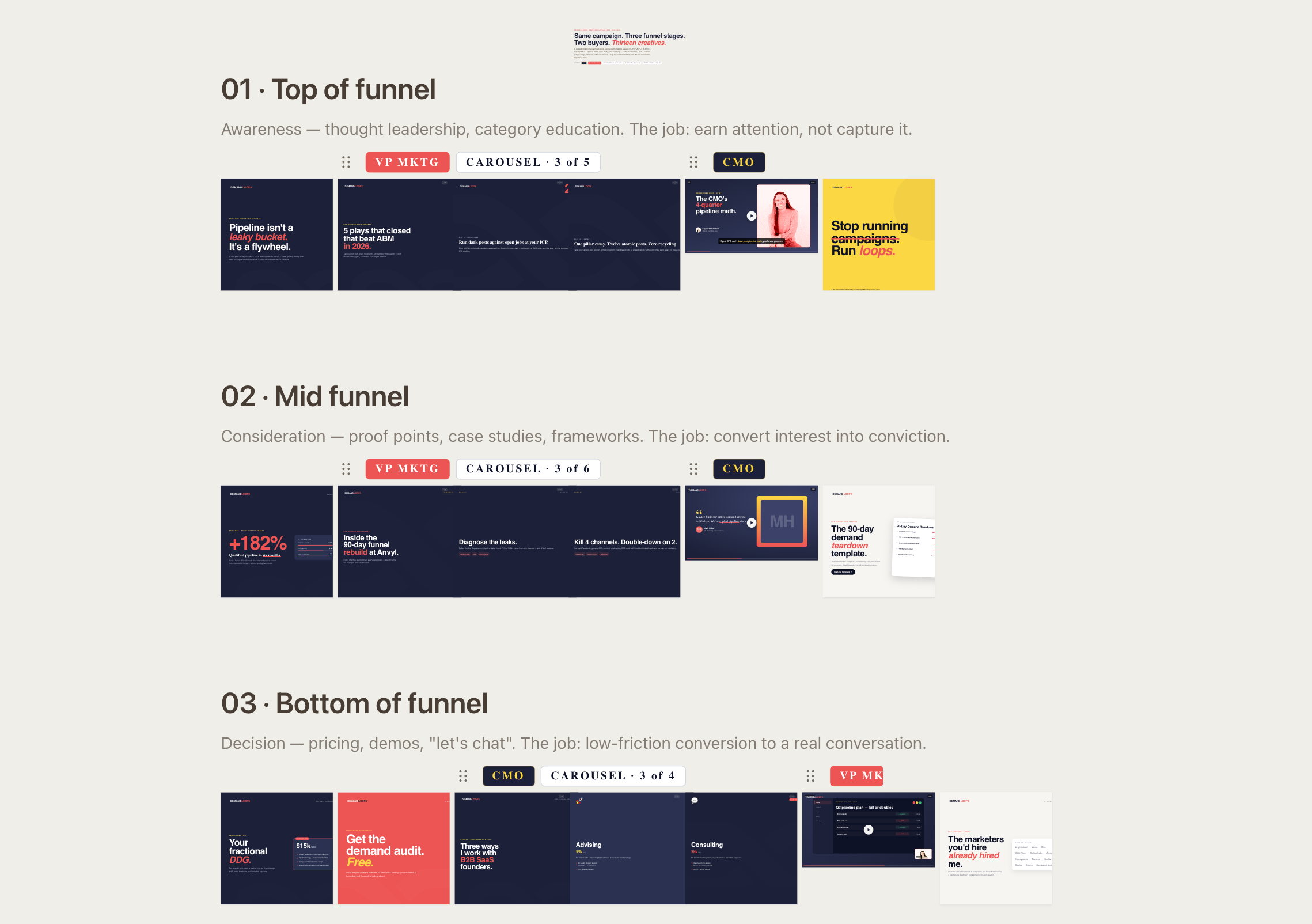
I’ve been using Claude Design + Canva to produce ad creative variants at a different pace:
Copy variations by persona.
Visual variants initiated in Claude Design, and tweaked to brand guidelines in Canva.
Format variants. Single image, carousel, and video thumbnail versions of the same campaign concept.
Stage variants. Top-of-funnel awareness creative (thought leadership, category education) vs. mid-funnel (proof points, case studies) vs. bottom-funnel (demo CTAs, pricing).
Instead of waiting days for 2-3 variants, you can have 10-15 ready in a single working session. You launch more variants, learn faster what resonates, and rotate creative before fatigue kills your CTR.
My next step is to create more of a closed-loop process so I can automate the performance learnings to create more informed future iterations.
Where to start: Copy variants on a single visual template before trying to generate entirely new visual concepts. Get the copy testing engine running first (5-7 headline/hook variants per campaign). Layer in visual variation once you have data on which messages are landing.
If you’re running AI-native demand gen plays I didn’t cover, reply to this email. I want to hear what’s working. Especially the unglamorous stuff.
See ya next week,
Kaylee ✌