

For the last few weeks I’ve felt long overdue for a brainstorm session with some peers. I know solopreneurship is all the rage, but the one drawback is having to form your own tribe, and then harass them regularly to get on a call with you. 🙃
So, that finally happened last week. We called it a “meeting of the minds.” I started by trying to be Type A and made us an agenda packed to the actual brim with ambitions to talk about everythinggggg. (Receipts for proof.)
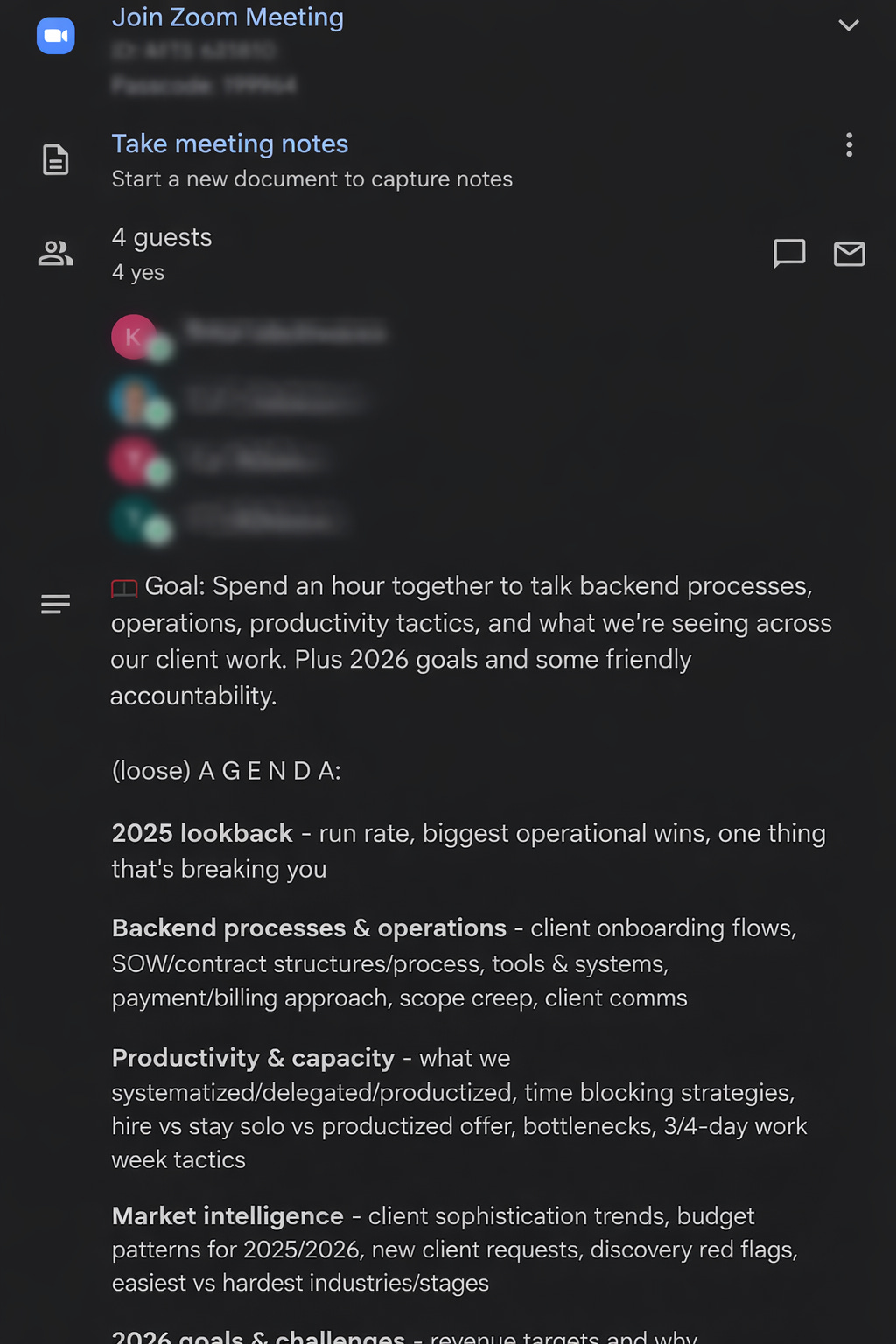
Naturally the call was off the rails (in the best way) about 6 minutes in. But we covered so much ground.
Small sidebar: I get asked often who my mentors are, how I’ve managed those relationships throughout my career, etc. Truthfully, I’ve never had a proper “mentor”. I’m inspired by so many people around me, that I know and plenty that I don’t actually have a relationship with at all. But I also acknowledge that I am trying to build a career that’s uniquely fit for me and each chapter has been wildly different if I’m being honest. So I’ve taken the ‘build your tribe’ route instead.
Earlier in my career my tribe were those around me modeling what I wanted to grow into at the time - head of demand gen. Then I had a chapter where I was determined to grow into a VP of Marketing role. Eventually, the corporate ladder started to break me and wasn’t allowing me the balance I needed to raise my young family so I shifted gears to the soloprenuer route. All of these chapters were inspired by different pockets of peers that acted almost like an informal board of directors.
This is the concept that’s always resonated most with me. I want people who have my best interest at heart, but that are also expected to push back, have opposing view points, take an argumentative angle to push me to create more clarity in my next steps.
👋 Hiii, it’s Kaylee Edmondson and welcome to Looped In, the newsletter exploring demand gen and growth frameworks in B2B SaaS. I write this newsletter every Sunday, and wildly, a few thousand of you read it each week. I’m grateful!
If you’re one of the newest 34 readers that have joined us since last week’s edition, welcome! Glad you’re here. I write what’s top of mind based on what I’m hearing across DemandLoops clients, networking calls, and friend groups. If there’s ever anything top of mind, shoot me a reply. I read every single one!
Board > Mentor
This call was exactly that kind of tribe moment. What was supposed to be 60 minutes turned into nearly 2 hours. Three marketers, three different business models, all wrestling with similar challenges.
We weren’t looking for a mentor to tell us what to do. We needed peers who’d push back, share what’s actually working (and what’s not), and help us think through our next moves.
Whether you’re solo or in-house, your board serves a different purpose than a mentor. They’re in the trenches with you, figuring it out in real time.
What stuck with me most
The pricing confidence gap
One person shared they’re charging $800/month for work that’s probably worth significantly more. Another had quoted $25K/month for a fractional CMO role and felt nervous about it.
We spent time talking about why we undercharge. It’s not because we don’t know our value—it’s because pricing based on value instead of time requires a different kind of confidence.
For solopreneurs, this shows up in client pricing. For in-house marketers, it shows up in how you position your work to leadership. Are you talking about hours spent on campaigns, or pipeline impact and revenue contribution?
If you’re consistently oversubscribed (with client work or internal requests), you have two options. Turn things down, or increase your perceived value. Most of us default to the first.
The productization tension
We talked about the balance between custom work and repeatable processes.
Every client or campaign is different. But having zero standardization means starting from scratch every time. This is that “niche down” topic that everyone is obsessing over on your LinkedIn feed. I’ve admittedly been very resistant to niche down as much as others have but feel I’ve found a middle ground with frameworks or what I refer to as “modules” inside of client engagements.
I have frameworks I use with every client—ICP definition, account tiering, signal identification. But the application is completely customized based on their situation.
For in-house marketers, this is about building your playbook. Campaign templates you customize. Launch processes you refine. Reporting frameworks you reuse.
Build the system once, use it forever (with iterations).
The isolation nobody talks about
This came up naturally: when you’re doing client work or executing campaigns, you’re collaborating constantly. But when you’re working on your business strategy or career development, you’re alone.
As a solopreneur, you’re in your clients’ businesses all day, but nobody is in yours. As an in-house marketer, you’re in campaign execution mode, but who’s helping you think strategically about your next career move?
This is exactly why calls like this matter. Not just for swapping tactics, but for the psychological reinforcement that these challenges are normal.
The value in pushback
We covered pricing strategies, backend operations, and some productivity tactics. But the real value was having people who could push back on our thinking.
When one person talked about their pricing, we didn’t just nod along. We asked questions. Challenged assumptions. Shared what we’re seeing across our own client bases.
When someone shared a productivity approach they’re testing, we talked through the trade-offs. What works in one business model might not work in another.
This is what a board does that a mentor can’t. They’re not giving you answers from a position of authority—they’re working through the same problems alongside you.
How I’ve been building mine
Based on my experience moving through different career chapters, here’s what’s worked:
Find people in similar transitions, not necessarily the same role. When I was going solo, I didn’t just talk to other marketing consultants. I talked to people making the shift from corporate to independent work across different functions.
Set expectations for honest pushback. The most valuable board members are the ones who’ll tell you when your thinking is unclear or your pricing is too low or your scope is too broad.
Make it regular but informal. We didn’t need a structured agenda (clearly, since we abandoned mine 6 minutes in). But having the call on the calendar made it happen.
Give more than you take. Come ready to share what you’re learning, not just what you need help with.
The paradox doesn’t go away
Whether you’re solo or in-house, you’re always balancing execution with strategy. Client work with business development. Tactical delivery with career growth.
But having a tribe of people who understand that tension, who are managing it themselves, who can push you to think more clearly about your next steps? That makes it manageable.
The call reminded me why I’ve always chosen the board approach over formal mentors. Every chapter of my career has been different. I need people who are figuring it out in real time, not people who figured it out 10 years ago in a completely different context.
Here’s to growth,
Kaylee ✌
P.S. - If you’re looking to build your own board or want to compare notes on any of this, hit reply. I read every response.
I like your tribe concept. It sounds to me less like what a mentor would do vs. what a coach would do. And while there are benefits to having both, the concept of having a "tribe of coaches" is awesome. A great athlete needs a great head coach but also the assistant coaches and specialists who come in with their unique point of view, knowledge and experience to help that athlete perform at the next level.
I view mentorship differently: A mentor offers long-term, holistic career guidance based on experience (wisdom-driven), while a coach provides short-term, structured support focused on achieving specific skill-based goals (performance-driven). Mentors share personal lessons and act as role models, often informally, whereas coaches use structured methods, ask powerful questions to help clients find their own answers, and may not have direct domain expertise.
Although in your case, the "tribe of coaches" actually had a lot of powerful direct domain expertise that was shared in the group setting to help you all advance in your own ways. So maybe there needs to be a third way to think of this type of "meeting of the minds".