

Marketers typically spend 98% of their time focused on external marketing, and the other 2% trying to recover for the week ahead.* Ok, I might’ve made that stat up entirely, but I’m sure it’s not far from the truth.
Most often what this means is there just isn’t any prioritization put around internal marketing to make sure your biggest evangelists—peers and employees—are informed of upcoming campaigns, have visibility into your metrics scorecard, and earn your marketing team more buy-in and momentum.
One solve: Show your work – Marketing should not be a mystery. We should be showing what we are doing internally with the marketing team, and regularly to cross-functional partners outside of marketing.
So, this week let’s talk about the power of starting a weekly internal marketing newsletter and what to include.
The cadence
In my opinion for an early-to-growth stage startup, internal newsletters should be sent weekly—either on Monday mornings or Friday afternoons. But just like anything else consistency is key. Ideally your audience grows to look forward to, and expect, a newsletter on X day from marketing. So if you can’t commit to weekly, start with bi-weekly and work your way up.
Call it something & kick it off with metrics
Call it a Weekly Marketing Roundup, or coin a name closer to your brand. At Chili Piper our internal newsletter was called The Sauce. Don’t overthink it.
Like any newsletter, these tend to work better when delivered in a narrative format. No one, not even your peer, wants to read through your list of weekly tasks. Kick off strong with a weekly summary of the most critical highlights, learnings, and/or wins. Keep it to 3 things or less.
Then, dive into the metrics. It's dangerous to track too many metrics in marketing, and would likely be detrimental to share a full stack of metrics broadly to the org without enough context.
When you measure everything, you measure nothing.
I've viewed countless dashboards and scorecards displaying every metric in the universe. It creates a false sense of accomplishment, and honestly it's confusing as hell.
You will have a happier, healthier, and more productive team if you focus on a finite set of metrics.
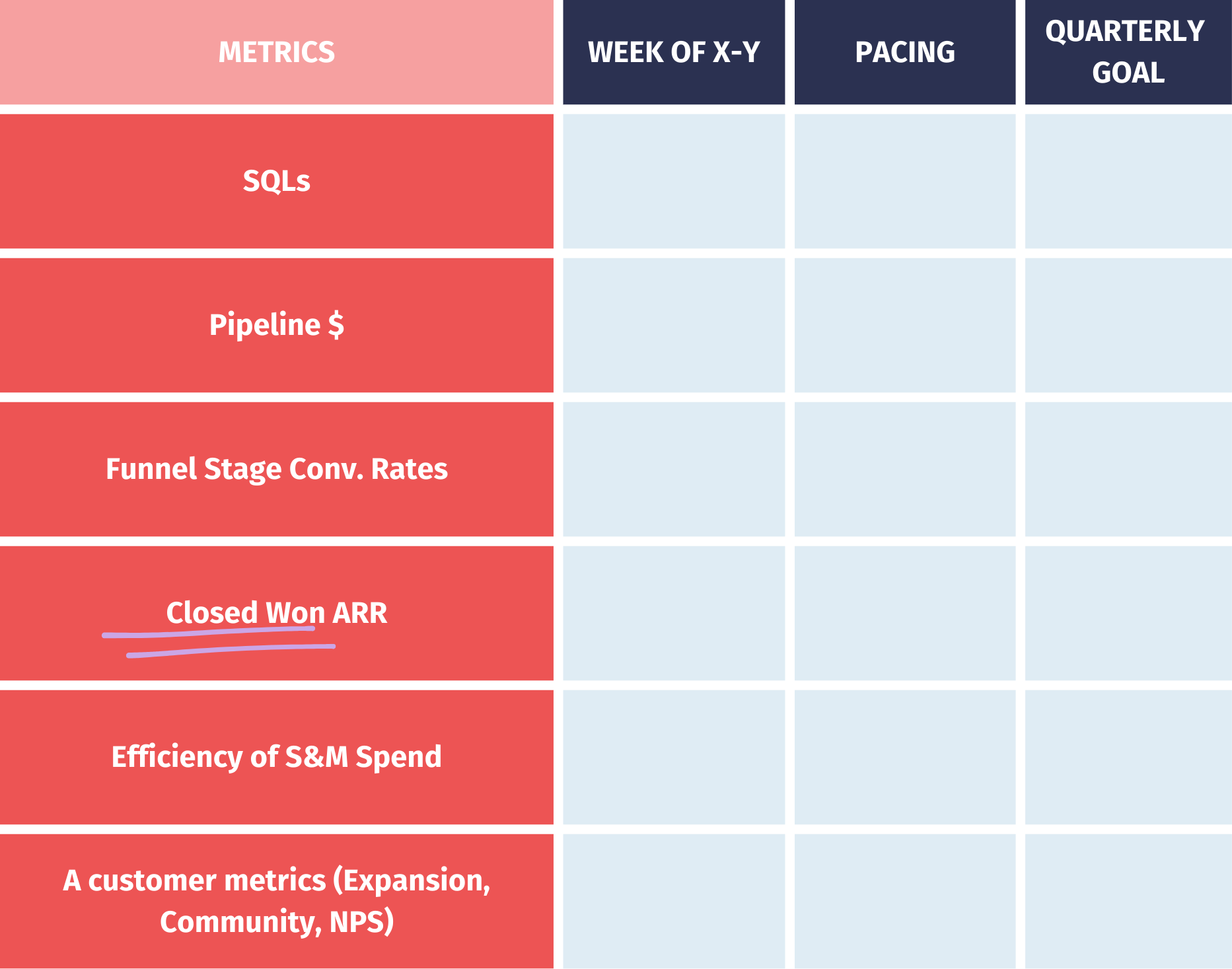
Pick 5 to 6 of your top metrics to measure and report out weekly. Pick 1 or 2 tests to perform bi-weekly to increase conversion.
Here are a few ideas to include on your scorecard:
The newsletter body
Campaign Spotlight: Deep dive into a specific campaign or project. Explain the goals, strategies, and expected outcomes. Share behind-the-scenes insights.
Customer Insights: Share notable customer feedback, testimonials, or case studies. If you don’t have a new case study to highlight for the week, grab a Gong recording from the week with a snippet highlighting an interesting learning.
💡 A tip to operationalize this: Add a folder in Gong for noteworthy listens. Enable your external-facing teams (Sales, Customer Success, Support, etc.) to tag their noteworthy calls within the week to that folder so you’re not left sifting through hundreds of hours of recordings each week. If you have a large company with multiple market segments (SMB vs Enterprise for example), I’ve seen it work best to have a dedicated noteworthy listens folder per segment.
Upcoming Campaigns: Provide a sneak peek of what’s coming up. I’ve found this enablement works best if shared over a Loom or some type of video where you can walk through the campaign objectives, the rollout, and any enablement or collateral share outs can be walked through in depth. And more importantly, you can then contextualize any asks you might have of the broader organization.
Upcoming Tactics: Undoubtedly each week you’ve have so many marketing activities moving even the marketing team might struggle to keep up with all the moving pieces. So, odds are your broader marketing org has little-to-know clue. Use this signoff section of the newsletter to walk through anything upcoming in the next few weeks (events, webinars, content drops, social activations, etc.). Anything upcoming the team should know about, keep it here. And don’t make them search for it. If you have hyper links to supporting materials, landing pages, artwork, etc. drop them in, too. The goal here is visibility and buy-in.
Everything needs a CTA…even internally
The first goal of a newsletter is consumption. Like I’d mentioned at the top, ideally it becomes habitual for team members to start off their Monday morning coffee reading your weekly digest. That in and of itself would be a huge win. But secondarily, it’s to create a feedback loop. Sign off every email with an ask. Could be something simple like asking what was the most insightful learning from this newsletter, or what they’d like to see covered in a future edition. Or you could ask the org to help you name your upcoming owned conference.
Here’s to internal alignment 🤝