

You can't open LinkedIn without being sold AI. The cold email in your inbox was probably written by AI. The newsletter about AI best practices was probably AI-assisted. It’s become all-consuming.
My feed looks and feels like this lately:
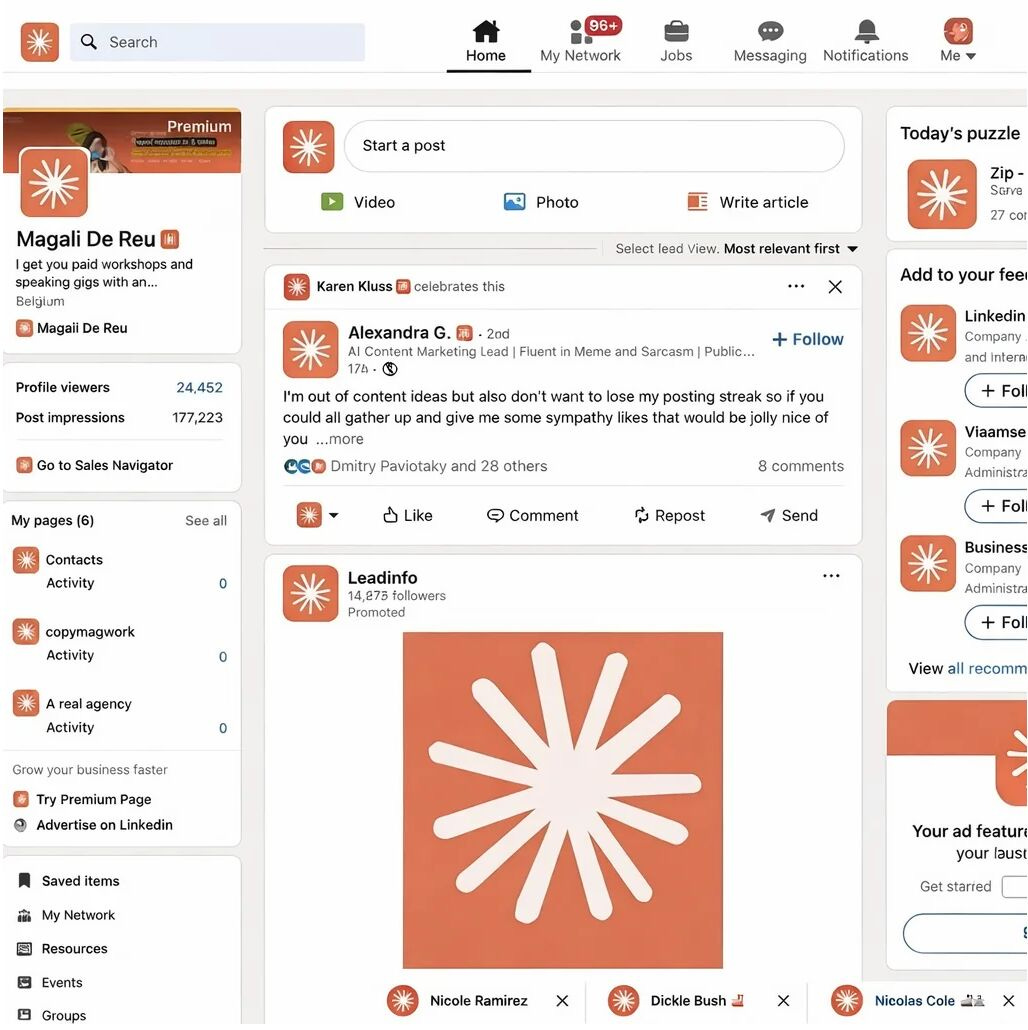
But what I’m observing inside marketing orgs right now – across clients, conversations, and peer communities – is a different story. Almost everyone is feeling behind. Almost no one can point to a concrete workflow where AI is producing better outcomes than what they had before. The mandate is real. The results mostly aren’t yet.
DG surveyed 100 CMOs recently and found that 85% named AI adoption as their top priority for 2026 and almost none felt far enough along. His read: “There’s a huge gap between perception and reality. What people are saying about AI on LinkedIn is dramatically different from what is actually happening inside a marketing org.”
This matches exactly what I’m seeing.
We’ve been here before. Just not quite like this.
B2B marketing has a long history of hype cycles, and they all follow the same arc: a new category emerges with genuinely compelling use cases, early adopters get results, the trade press picks it up, LinkedIn turns the volume to eleven, the board starts asking questions, budgets get allocated, tools get purchased, rollouts happen — and then, about 12-18 months later, most teams are sitting on a piece of expensive tech debt and wondering what went wrong.
I’ve watched it happen enough times to recognize the pattern by feel.
HubSpot and the inbound marketing wave in the early 2010s. The promise was that you could replace interruption-based marketing with content that buyers would come to you for. Real for some companies, absolutely. For many others: a blog nobody read, an ebook that generated zero pipeline, and a CMS contract that outlasted three CMOs.
Conversational marketing and the Drift era. The promise was that AI-powered chat would transform how B2B companies captured and qualified pipeline. Real for some companies. For many others: a chatbot icon on the website, a sales team that ignored the alerts, and a multi-year contract nobody wanted to renew.
Dark social. Zero-click content. ABM platforms at $150K+ annually. Each one has had a hype cycle. We are marketers after all. 😏
Which brings us to AI.
I want to be careful here, because I genuinely believe this one is different. Not different in kind, the hype cycle is running the same playbook, but different in scope and intensity. The investment levels are bigger. The board pressure is more universal. The category is broader, touching every function, every role, every workflow simultaneously. And the FOMO is more acute than anything I’ve ever seen, because unlike ABM or dark social, AI feels existential in a way that a marketing channel never did.
So what’s the diagnosis, doc?
Most companies aren’t buying AI tools because they’ve identified a specific problem and need to scale the solution. They’re just not. They’re doing it because they’re terrified of being the one who didn’t.
When you buy to reduce FOMO, you buy the wrong thing, for the wrong reasons, before you’re ready to use it. This was true for non-AI tech stacks and I believe it carries through to this era, too.
Devin Reed put it cleanly in a recent newsletter: “You can’t scale a process you haven’t built. You can’t automate thinking you haven’t documented.”
Generic prompt in. Generic content out.
Turns out this thing needs a brain
As I’ve spent my last several weeks obsessing over Claude Cowork, through much trial and error I’ve found the output is substantially better if you give Claude a “brain”. Claude is only as useful as what you tell it. Out of the box, it’s a generalist. But if you spend time upfront loading your context into Claude Cowork’s CLAUDE.md file, it becomes something closer to a second brain that knows your stack, your audience, your voice, and your opinions.
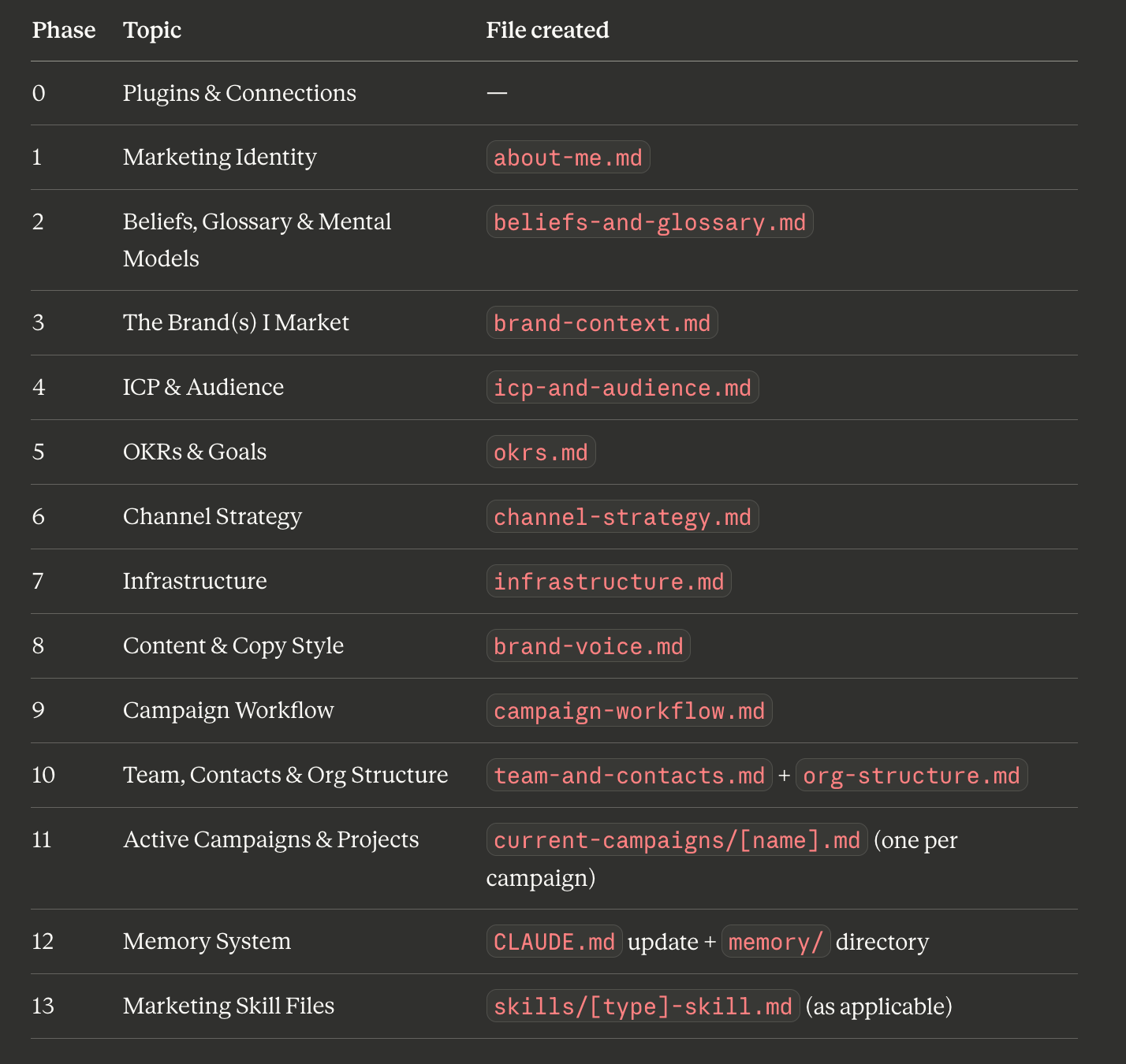
This is the prompt structure I’ve used. The good news is you can and should make this entirely your own. You can also go back and build new phases over time once you get into a new project and realize Claude has no idea what you’re talking about. To start, there are XX phases in this initial prompt. It interviews you one phase at a time, builds a structured file after each phase, waits for your approval, then moves on. When it’s done, you have a complete marketing brain that makes Claude useful from the first message of every future session.
And if you go implement this and have learnings, feedback, questions, etc. hit reply! I really read every one.
Phase Map
The Prompt
Copy everything and paste it into Claude Cowork as your first message.
👋 Hi, I’m Kaylee Edmondson. Looped In lands in your inbox every Sunday with one goal: to give you a sharper way to think about demand gen and growth in B2B SaaS. 2k+ marketers are already reading it. If you’re not subscribed yet, fix that below.