

Every conversation about AI and tech debt is focused on engineering. Copilot is writing 41% of all new commercial code. AI-generated pull requests have 1.7x more issues than human-written ones. Maintenance costs are climbing. CTOs are quietly (or sometimes loudly) panicking.
That’s real. But there’s a version of this problem taking shape inside GTM teams right now, and nobody’s talking about it yet.
I’ve spent years getting called in to clean up demand gen messes. New client, same story: six tools that don’t talk to each other, UTMs that break halfway through the funnel, ICP data baked into a scoring model that nobody’s validated since 2021, content that was “the old team’s stuff.” I joke that half my job is janitorial work before the actual strategy can start.
Pre-AI, this was manageable. Messy, yes. But the mess had a speed limit. Adding a new tool required a budget conversation. Building something custom required engineering resources. The chaos had friction built in.
AI took nearly all the friction away.
👋 Hi, it’s Kaylee Edmondson and welcome to Looped In, my newsletter exploring demand gen and growth frameworks in B2B SaaS. Subscribe to join 2k+ readers who get Looped In delivered to their inbox every Sunday.
Everyone’s a product builder now
AI has made something genuinely remarkable possible: a non-technical employee can now build a functioning tool.
Your demand gen manager can spin up an account scoring workflow in an afternoon. Your SDR can build an enrichment pipeline that pulls from multiple data sources and outputs a prioritized list every morning. Your content person can automate a reporting dashboard. Your ops person can create a routing logic tool that actually works.
Five years ago, any one of those projects would have required an engineering ticket, a sprint, a product manager, and a multi-week wait.
It’s amazing on one hand because teams are moving so fast. And I love that. The builder in me is so pumped. People can now self-serve and solve their own problem set.
But this also means your employees are building tools inside your GTM stack that you have no visibility into, no inventory of, and no governance over. 🙃
The Jim and Tina problem
A month ago I was doing an audit for a client. Mid-market company, solid team, well-funded. In the course of mapping their marketing infrastructure, I found something interesting.
Two people on the same team had independently built almost identical lead prioritization tools. One lived in Notion with some AI automation layered on top. The other was a Zapier workflow feeding into a Google Sheet. Both were pulling from HubSpot. Neither was pulling from the same fields though. …And neither person knew the other’s tool existed.
Their outputs conflicted. SDRs were getting inconsistent signals depending on who they talked to. Nobody could figure out why their pipeline data looked different in different reporting contexts.
I call this the Jim and Tina problem - their real names have been redacted, obviously. Jim and Tina are both solving the same problem, independently, with AI tools that nobody asked them to build and nobody knows about.
This isn’t a one-off. I’m seeing versions of it at every client I work with now. The tools are different, the functions are different, but the pattern is the same: employees are building, nobody’s coordinating, and the mess is silently compounding.
Why the old playbook doesn’t catch this
Marketing has had a sprawl problem for years. The 2025 marketing technology landscape counted 15,384 martech tools. We’ve been talking about stack bloat for a decade or more.
But the old version of this problem was at least visible. A new tool purchase showed up in a contract. In a budget. In a vendor renewal. Even shadow IT left some footprint.
AI-built internal tools have minimal footprint so far. They live in someone’s personal Notion. They run on free tiers of Zapier. They’re a Claude prompt that gets copy-pasted every Monday morning. They’re invisible to procurement, invisible to IT, and invisible to the people responsible for GTM infrastructure.
Nobody owns this. That’s the problem.
If you asked your CMO who’s responsible for tracking what AI tools their team is building, they’d probably say IT or RevOps. If you asked RevOps, they’d say IT or Marketing Ops. If you asked IT, they’d say they don’t have visibility, it’s on the manager.
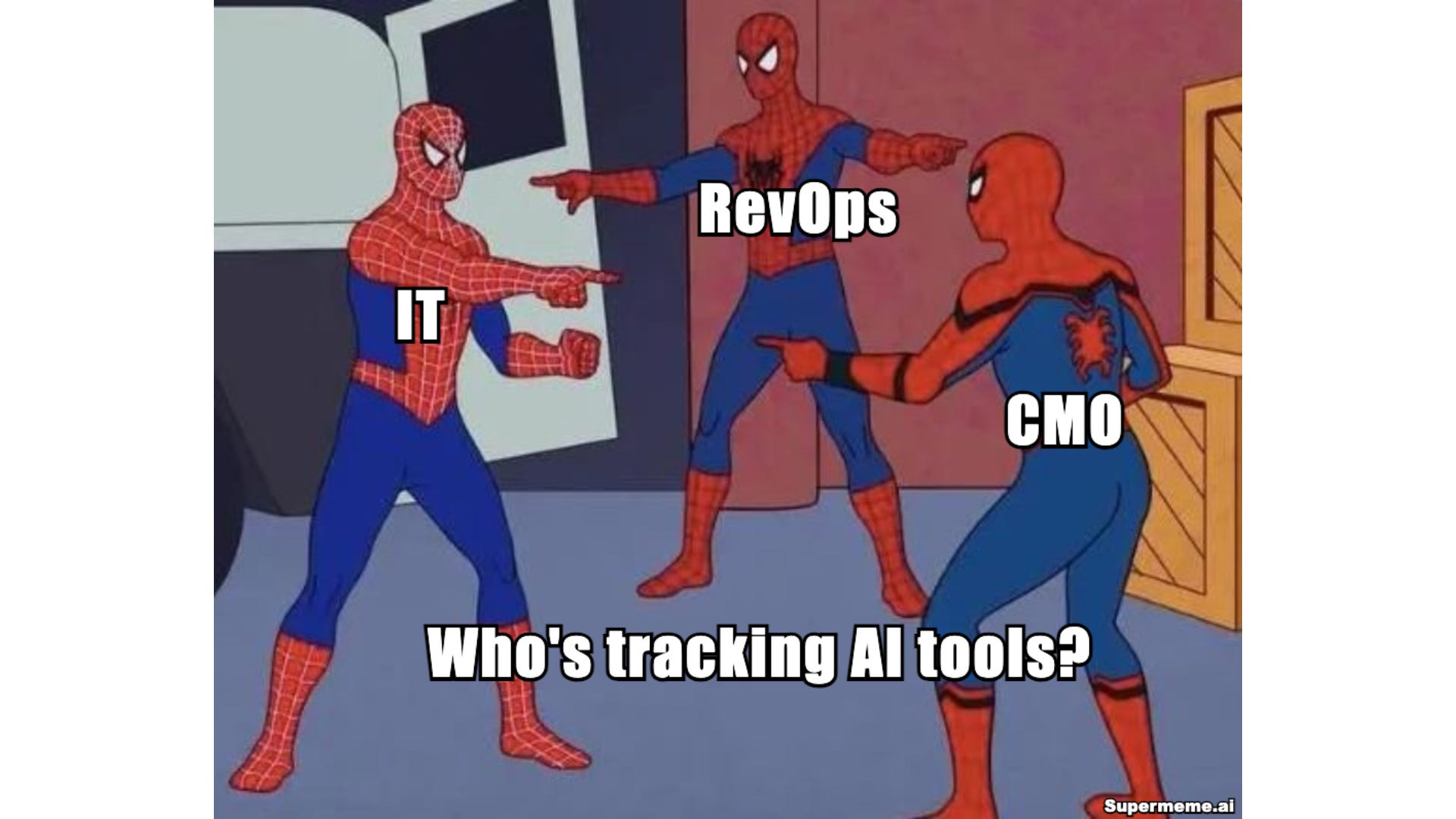
Nobody owns it. And the reason nobody owns it is that the problem is new enough that it doesn’t have a designated home yet.
The closest thing most orgs have is RevOps, and RevOps is already stretched. Managing the CRM, the attribution stack, the reporting layer, the sales enablement tooling, commission planning, the list goes on. Asking them to also audit every AI tool a 50-person GTM team is quietly building is just wild.
Over time, I think companies are going to need a dedicated internal AI governance function of sorts. Someone whose job is to know what’s being built, by whom, what data it’s touching, and whether it duplicates something that already exists.
We don’t have good models for what that role looks like yet. But the need is already here.
What this means for demand gen specifically
If you’re running demand gen at a B2B SaaS company right now, the AI tools your team is quietly building are touching the things you care most about: lead data, scoring signals, campaign attribution, funnel metrics.
When those tools are ungoverned, the downstream effects show up in the places you’ll notice last. A critical workflow that’s now broken by upstream changes. A pipeline report that’s falsely inflated. A segment pulling the wrong contacts because someone’s automation changed a field value.
These aren’t catastrophic failures. They’re the slow, hard-to-diagnose kind. The kind where you spend days ruling out obvious causes before someone finally surfaces the rogue workflow.
What you can do right now
You probably can’t stop your team from building. Nor should you. The productivity gains are real, and telling people to stop using AI tools is a battle you’ll lose.
But you can get visibility.
Start with a simple inventory. Ask your team, in a meeting or a quick async channel, to share any AI tools or automations they’ve built or are currently using. You’ll be surprised what surfaces. Make it a safe ask, not an audit. Frame it as “I want to make sure we’re not duplicating effort.”
Designate someone to own the map. It doesn’t need to be a full-time job yet. But someone on your team should be responsible for knowing what’s running. Even a shared doc with tool name, owner, what data it touches, and what it does is a massive improvement over nothing.
Establish a lightweight review before anything writes to your CRM. This is the highest-risk category. Reading data is relatively safe. Writing data back is where things go sideways. Create a simple norm: if a tool is writing to HubSpot or Salesforce, it needs a second set of eyes before it goes live.
Check for duplication before you build. Before you or your team starts a new AI project, spend five minutes asking whether someone’s already solved this. The Jim and Tina problem is mostly a communication problem. A quick “has anyone built X?” in Slack goes a long way.
None of these are complicated. They’re just not happening at most companies right now.
The companies that build governance habits early, before the mess gets unmanageable, are the ones that won’t need a janitor later.
See ya next week,
Kaylee ✌